
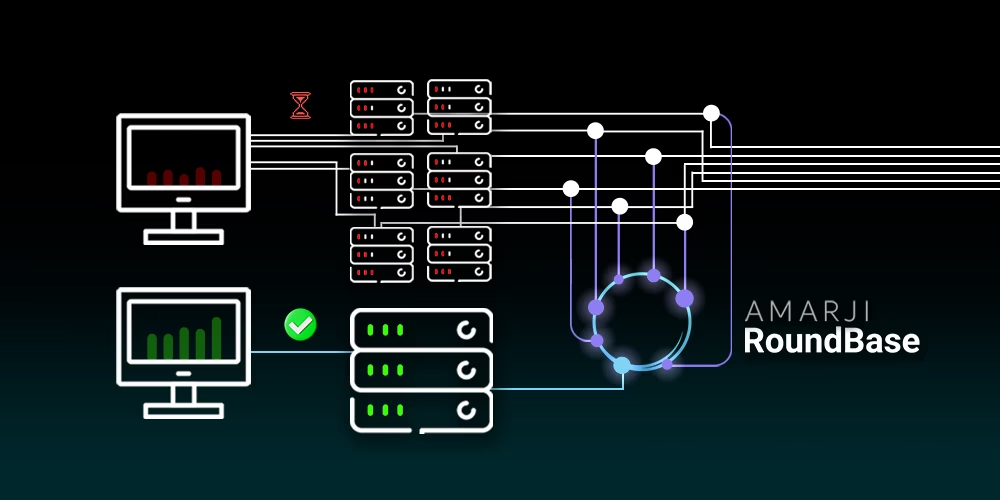
Operational data is everywhere. Routes, fuel, vehicles, timesheets, trackers, finance systems, and spreadsheets all hold something useful, but none of them hold the full picture on their own. For many waste and logistics teams, this means insight arrives late, reporting is manual, and answers take more effort than they should. Not because the data is poor, but because it has never had a proper place to come together.
Over time, teams adapt. Spreadsheets fill the gaps, reports get built by hand, and knowledge starts to live with individuals rather than the business. For a while, that approach works well enough. Then the effort quietly begins to outweigh the benefit, and reporting starts to feel heavier than it should.
The issue is not data volume. It is fragmentation
Most operational businesses are not short on data. They are short on consistency. When information is spread across multiple systems and formats, every report becomes a small integration project, with data needing to be extracted, cleaned, reconciled, and checked before it can be trusted.
By the time that work is done, the opportunity to act has often passed. Reporting feels slow and laborious, not because teams lack capability, but because the foundations underneath the data were never designed to support day-to-day decision making at scale.
Why platforms often add to the problem
In theory, analytics platforms should solve this problem. In practice, they often introduce a different kind of complexity. Many require specialist skills to build and maintain, while others depend on internal data teams that operational businesses may not have.
Over time, the burden shifts rather than disappears. Dashboards exist, but confidence does not. Reporting still relies on manual steps, ownership becomes unclear, and costs creep up quietly in the background. What teams usually need is not another tool to manage, but something that runs reliably without demanding constant attention.
A different approach to operational analytics
RoundBase was built in response to these patterns. It is a fully managed data and analytics platform that brings operational data together into a single, secure environment. Data is ingested automatically, business logic is applied consistently, and curated datasets and dashboards are delivered ready for everyday use.
Everything is built, run, and supported by Amarji. There is no need for an internal BI team or ongoing engineering effort. The platform is designed to feel dependable rather than impressive, and in practice, it simply works.
Control stays where it should
A key principle behind RoundBase is ownership. Clients retain full access to their curated datasets for their own reporting and analysis. If RoundBase is ever cancelled, all combined datasets, raw source data, and associated Power BI files are provided.
There is no lock-in and no loss of control. This means the platform supports the business without trapping it, and data remains an asset rather than a dependency.
Built for real operational environments
RoundBase runs on a secure Microsoft Fabric lakehouse, with data encrypted at rest and in transit, role-based access control, and UK or EU data residency. Support is practical and layered, reflecting the realities of operational environments.
Day-to-day questions are handled by the Amarji help desk, covering data, dashboards, and pipelines. Platform-level support is backed by Microsoft. The structure is designed to work reliably in real conditions, not ideal ones.
Predictable costs, fewer moving parts
Rather than paying separately for infrastructure, licences, development, and support, RoundBase bundles everything into a single monthly cost. This removes much of the hidden overhead that often comes with enterprise grade analytics.
Costs become easier to understand and plan for, and the focus stays on value rather than maintaining the platform itself.
When data stops being a distraction
The real benefit of RoundBase is not the technology. It is what changes once the foundations are in place. Reporting takes less time, numbers are easier to trust, and teams spend more time reviewing information and less time preparing it.
Operational data finally has somewhere to live, and the business begins to feel lighter as a result.
A quieter launch, by design
RoundBase is not a big reveal. It is a response to patterns Amarji has seen repeatedly across waste, logistics, and other operational businesses. When data is easier to access, work becomes calmer, decisions come sooner, and reporting returns to what it was always meant to be.
If you are curious whether RoundBase could remove some of the weight from your reporting, we are always happy to talk it through and see if it fits.