
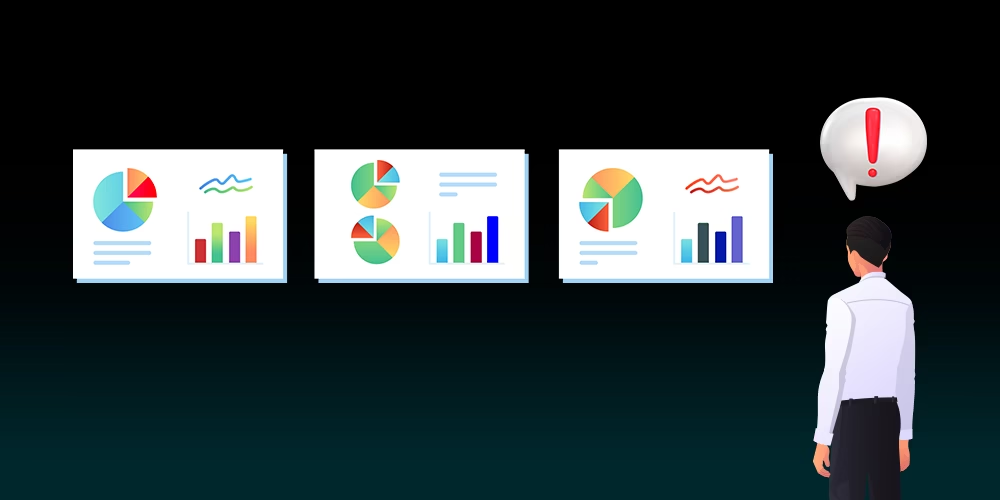
Most reporting environments do not start out complicated. A metric gets added to answer a question, another dashboard gets built to track something more closely, and at the time, each decision makes complete sense. The problem is that this tends to happen across every team, over a long enough period, that what was once a clear view of the business becomes something much harder to read. Nobody planned for it to feel that way. It just does.
For a lot of leaders, the issue is not that the data is missing. It is that there is so much of it that the things worth paying attention to get lost in everything else. That gap between having information and actually being able to use it is where a lot of time quietly disappears.
When more reporting creates less clarity
There is a reasonable assumption that more dashboards mean more control, but in practice, that is not always how it plays out. When every team is working from its own set of metrics and its own set of views, the volume of reporting grows faster than the ability to make sense of it. Signals that should be obvious become easy to miss, and a disproportionate amount of time goes into moving between reports rather than acting on what they say.
Harvard Business Review has written about this tension, making the point that too much measurement can actually slow decision-making rather than improve it. The problem is not getting hold of data. It has a clear enough picture to know which data is telling you something important and which is just filling space.
What leaders are actually looking for
When you ask most leaders what they want from their reporting, the answer is usually some version of the same thing. They want to know what is changing that should not be, where something is starting to drift, and what needs a decision today rather than at some point later in the week. That is not a complicated ask, but a lot of reporting environments are not set up to answer it cleanly.
Instead, they are built to show everything, which sounds thorough but in practice means the most important things compete for attention alongside everything else. By the time a leader has found what they were looking for, the morning has already moved on.
The difference a focused view makes
When reporting gets simplified, the difference tends to show up quickly and in fairly practical ways. Rather than starting the day by working out where to look, there is a clearer starting point, a small number of indicators that reflect how the business is actually doing, and variations that stand out rather than getting absorbed into a busier picture.
The point is not to strip everything back for the sake of it. Detail still matters, and the ability to go deeper when something needs investigating is genuinely useful. The shift is more about making sure that the things most worth knowing are the first things you see, rather than something you arrive at after a lot of searching.
From volume to focus
Reporting tends to grow towards volume slowly and without much drama. Each addition is justifiable, each new view answers a real question, and nobody sits down and decides to make things harder to navigate. It happens incrementally, and by the time it starts to feel like a problem, the habit is already well established.
Coming back from that is usually less about technical change and more about being willing to ask a more focused question. Not what else could be measured, but what actually needs to be visible, and for whom. Once that question gets a clear answer, the structure tends to sort itself out.
A clearer start to the day
The leaders who seem to get the most out of their reporting are not necessarily the ones with the most sophisticated dashboards. They tend to be the ones who are clear about what they need to see and have a setup that makes it easy to find. A handful of indicators, a reliable read on what is changing, and enough context to make a call without having to dig for it first.
If reporting currently feels like it takes more effort than it gives back, that is usually a sign that focus has drifted somewhere along the way. It is worth asking what a genuinely useful morning view would actually look like, because for most businesses, the answer is probably simpler than what currently exists.